📱 Mobile Phone Detected
This full brief is optimized for desktop/tablet viewing. For mobile, please read the 2-minute TL;DR version or switch to a larger screen for the best experience.
EXECUTIVE SUMMARY
During the week of December 13–19, 2025, threat activity centered on active exploitation of a long‑standing Sierra Wireless AirLink ALEOS router RCE (CVE‑2018‑4063), a newly patched but exploited SonicWall SMA 100 privilege escalation (CVE‑2025‑40602), widespread React2Shell (CVE‑2025‑55182) compromises, and ongoing campaigns by China‑ and Russia‑aligned actors. Multiple vendors and CISA confirmed active exploitation, placement into the KEV catalog, and real‑world breaches across cloud, industrial, and web stacks. SOC teams should prioritize patching internet‑facing routers, VPNs, and React deployments, implement network‑layer controls for known C2, and deploy standardized Sigma/YARA/Snort rules provided in this briefing to detect post‑exploitation activity rapidly.
⚡ Short on time? Read the 2-minute TL;DR version for quick mobile-optimized threat intel.
TRENDING SECURITY NEWS
React2Shell Fallout and Cloud Outages
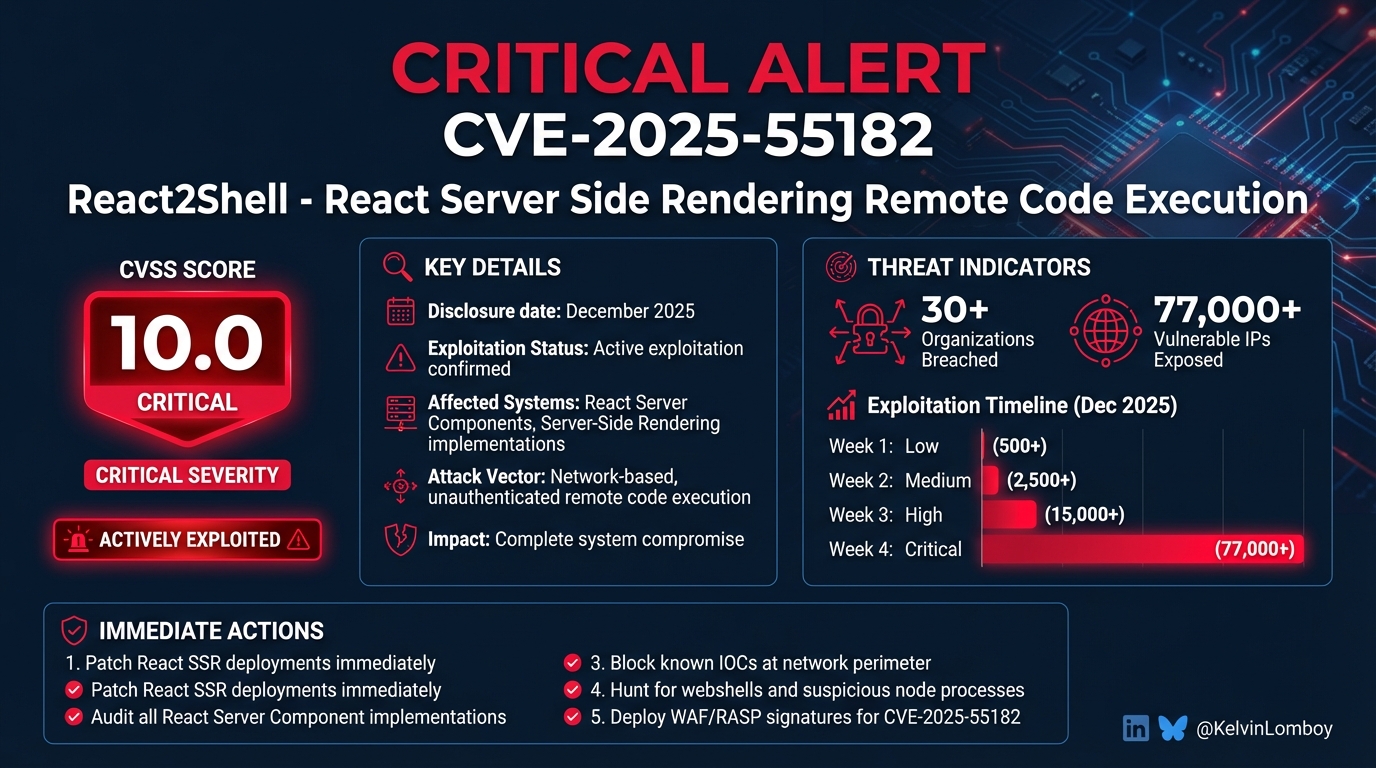
What: The React2Shell remote code execution flaw (CVE‑2025‑55182) continued to dominate discussion as reports confirmed at least 30 organizations breached and more than 77,000 internet‑exposed IPs vulnerable; Cloudflare acknowledged that emergency mitigations for React2Shell contributed to a notable outage.
Why it’s trending: Defenders are debating the framework supply‑chain risk, whether React SSR and server components can be safely exposed, and how to harden CI/CD and edge infrastructure after Cloudflare’s availability impact.
Relevance: SOC teams must treat public React SSR endpoints as high‑risk, hunt for webshells and suspicious node/Unix processes, and verify that WAF and RASP signatures for CVE‑2025‑55182 are active.
Sierra Wireless ALEOS Routers: Old CVE, New Exploitation
What: CISA added CVE‑2018‑4063, an unrestricted file‑upload flaw in Sierra Wireless AirLink ALEOS routers, to the KEV catalog after confirmed active exploitation in industrial and transportation environments.
Why it’s trending: Community discussion is focused on legacy OT/IoT exposure, the danger of seven‑year‑old bugs in field‑deployed devices, and the practical challenges of replacing or segmenting routers used in utilities and fleets.
Relevance: Network defenders must inventory ALEOS‑based routers, restrict ACEmanager access, and monitor for suspicious file uploads and command execution from management interfaces.
SonicWall SMA 100 Zero‑Day Exploited (CVE‑2025‑40602)
What: SonicWall released emergency hotfixes for CVE‑2025‑40602, a local privilege escalation in SMA 100 appliances exploited as a zero‑day, discovered by Google’s threat team and confirmed in the wild.
Why it’s trending: Posts on SecOps and vendor blogs outline realistic exploit chains where CVE‑2025‑40602 is chained with a separate remote bug CVE‑2025‑23006 to gain root and full VPN gateway compromise.
Relevance: SOC teams should treat unpatched SMA 100s as potentially compromised, apply hotfixes, and review authentication logs, configuration changes, and shell access to appliances.
Apple WebKit Zero‑Days and Chrome In‑The‑Wild Exploit
What: Apple shipped patches for two actively exploited WebKit bugs CVE‑2025‑14174 and CVE‑2025‑43529, while Google released an emergency Chrome update to fix an in‑the‑wild zero‑day tracked internally as issue 466192044.
Why it’s trending: Researchers see these as further evidence of mercenary spyware operations and browser‑based exploit chains targeting high‑value mobile and desktop users.
Relevance: Enterprises should accelerate mobile and browser patching, enforce modern browser versions in VDI and managed endpoints, and monitor for suspicious browser child processes or sandbox escapes.
Russia‑Aligned and China‑Aligned Infrastructure Campaigns
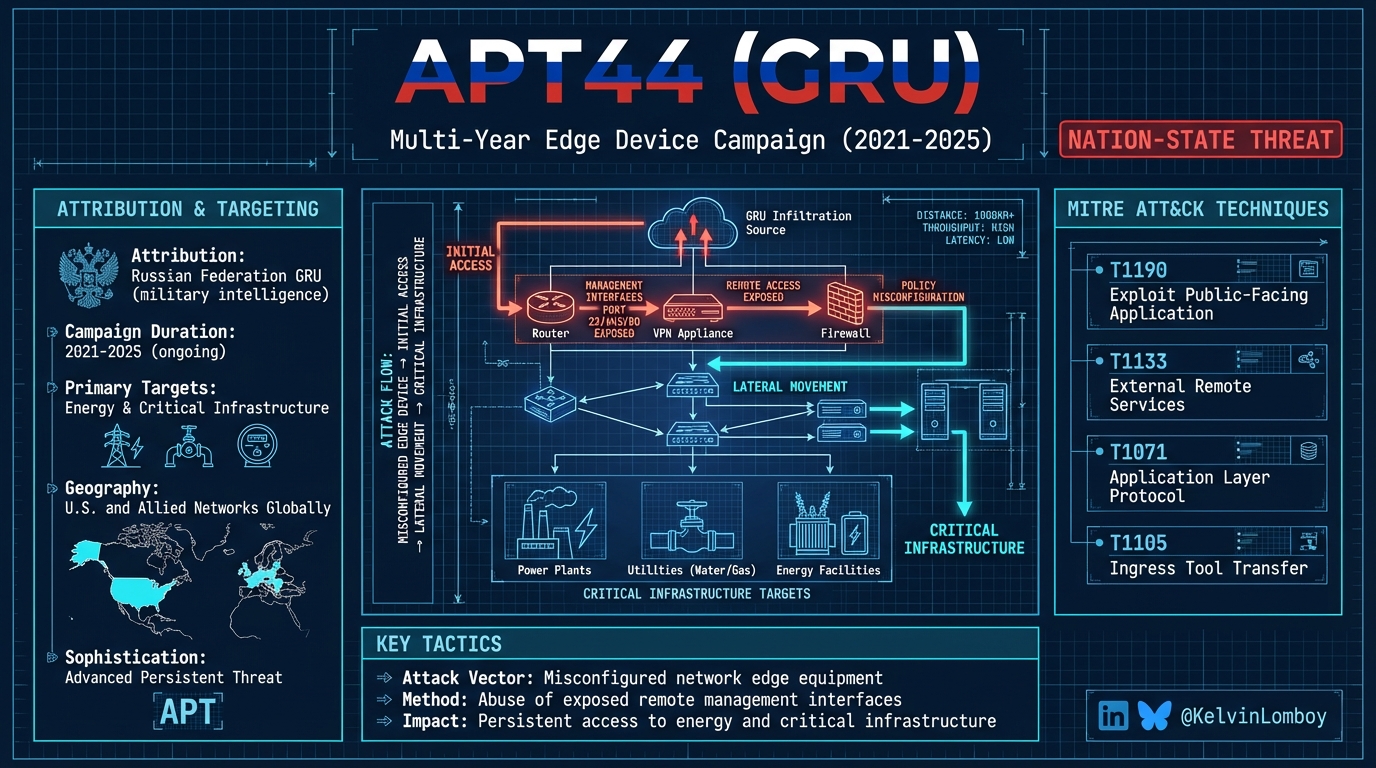
What: Amazon’s security team exposed a years‑long GRU APT44 campaign abusing misconfigured network‑edge devices in energy and critical infrastructure, while CISA and partners highlighted China‑aligned BrickStorm malware on VMware vSphere and ESXi as well as broader VNC‑based OT attacks by pro‑Russia hacktivists.
Why it’s trending: The community is focused on systemic weaknesses in edge appliances, VNC exposure, and hypervisor security, and on how nation‑state actors blend crimeware‑like tradecraft with advanced persistence.
Relevance: SOCs should review exposure of VNC, VPNs, VMware management interfaces, and apply hardening baselines while deploying new hypervisor‑aware detection for BrickStorm‑class implants.
ORGANIZATIONS BY THREAT EXPOSURE (Dec 13 - Dec 19, 2025)
━━━━━━━━━━━━━━━━━━━━━━━━━━━━━━━━━━━━━━━━━━━━━━━━━━━━━━━━━

CRITICAL INFRASTRUCTURE (Energy, Utilities, Transport)
  Threats:  ▓▓▓▓▓▓▓▓░░  High
  Critical: ▓▓▓▓▓▓░░░░  Elevated
  Primary vectors: Exposed routers (ALEOS),
    misconfigured edge, VNC to OT.

CLOUD & SAAS
  Threats:  ▓▓▓▓▓▓▓░░░  High
  Critical: ▓▓▓▓▓░░░░░  Elevated
  Primary vectors: React2Shell on SSR, Chrome/Apple
    browser 0‑days, compromised developer endpoints.

ENTERPRISE & GOVERNMENT IT
  Threats:  ▓▓▓▓▓▓░░░░  Medium‑High
  Critical: ▓▓▓▓░░░░░░  Moderate
  Primary vectors: SonicWall SMA 100, VMware BrickStorm
    implants, phishing.

INDUSTRIAL & OT
  Threats:  ▓▓▓▓▓░░░░░  Medium
  Critical: ▓▓▓░░░░░░░  Emerging
  Primary vectors: ALEOS routers, VNC into ICS/SCADA,
    APT44 GRU campaigns.
CRITICAL VULNERABILITIES (Top 5)
4.1 React2Shell – React Server RCE (CVE‑2025‑55182)
CVE / Severity / Status: CVE‑2025‑55182, critical RCE; observed active exploitation with over 30 confirmed victim organizations and ~77k exposed IPs.
Affected products: React applications using vulnerable React Server Components / SSR patterns, including popular frameworks and custom node‑based backends; exploitation seen across multiple sectors.
Attack vector: Remote unauthenticated attackers send crafted HTTP requests exploiting path traversal and improper template handling to execute arbitrary system commands as the web server user, often writing webshells or launching reverse shells.
IOCs and behaviors:
Sudden appearance of suspicious files (e.g., .js, .sh, or binary webshells) under application or node_modules directories after unusual POST requests.
Webserver logs showing commands such as id, cat /etc/passwd, and attempts to write files in app directories.
Observed malware families Snowlight and Vshell used post‑exploitation in some campaigns.
Detection guidance:
See Sigma Rule: React2Shell_CVE_2025_55182_PostEx in Section 9.
search in web_logs
where http_method == "POST"
and url_path like "%react%"
and status in (200, 201, 204)
and (request_body contains "require('child_process')"
or request_body contains "process.mainModule.require")
and bytes_out > 50000
Remediation:
Upgrade React / framework components to vendor‑specified fixed versions and apply any provided mitigations or feature flags disabling vulnerable server components.
Deploy WAF rules or reverse‑proxy filters blocking known exploit patterns, restrict direct internet exposure of SSR backends, rotate application secrets, and re‑issue credentials where compromise is suspected.
CVE / Severity / Status: CVE‑2018‑4063, high/critical RCE (CVSS 8.8–9.9) added to CISA KEV December 13, 2025 with confirmed active exploitation.
Affected products: Sierra Wireless AirLink ALEOS routers widely deployed in utilities, transportation, and industrial remote connectivity.
Attack vector: Authenticated attackers abuse ACEmanager’s upload.cgi, which fails to restrict upload types; weak or default credentials allow adversaries to upload arbitrary executable files and then trigger them for remote code execution.
IOCs and behaviors:
HTTP POSTs to /cgi-bin/upload.cgi from unfamiliar IPs, often followed by configuration changes or reboots.
Presence of unexpected binaries or scripts in router filesystem locations used for configuration or updates.
Detection guidance:
See Sigma Rule: SierraWireless_ALEOS_CVE_2018_4063_Abuse in Section 9.
search in firewall_http_logs
where dst_device == "ALEOS"
and url_path == "/cgi-bin/upload.cgi"
and http_method == "POST"
and (file_type not in ("cfg","bin","fw","xml"))
Remediation:
Where supported, apply latest ALEOS firmware that addresses CVE‑2018‑4063 or vendor‑recommended mitigations; if not supported, plan accelerated replacement.
Immediately restrict ACEmanager to a management VLAN or VPN, enforce strong unique credentials, disable remote admin from the public internet, and monitor for anomalous uploads and CLI actions.
4.3 SonicWall SMA 100 – Appliance Management Console LPE (CVE‑2025‑40602)
CVE / Severity / Status: CVE‑2025‑40602, medium (CVSS 6.6) but actively exploited zero‑day, enabling local privilege escalation in SMA 100; often chained with remote exploit CVE‑2025‑23006 for full compromise.
Affected products: SonicWall Secure Mobile Access (SMA) 100 series appliances on vulnerable firmware prior to hotfix builds (e.g., 12.4.3‑03245 and 12.5.0‑02283 or later).
Attack vector: Due to insufficient authorization checks in the Appliance Management Console (AMC), authenticated users or code can escalate privileges to root, especially dangerous when combined with external RCE to pivot from web access to full system control.
IOCs and behaviors:
Unusual root‑level processes or shell sessions on SMA appliances initiated shortly after config or user‑management changes.
Log entries for non‑admin users invoking privileged AMC endpoints or configuration exports.
Detection guidance:
See Sigma Rule: SonicWall_SMA100_PrivEsc_CVE_2025_40602 in Section 9.
search in vpn_appliance_logs
where product == "SonicWall SMA"
and event_type in ("config_change","system_command")
and actor_role != "admin"
Remediation:
Apply SonicWall platform‑hotfix patches (e.g., 12.4.3‑03245+ or 12.5.0‑02283+) and consider decommissioning end‑of‑support SMA 100 devices.
Restrict management access to internal or admin networks, enforce MFA for admin accounts, review logs for signs of chaining with remote exploits, and reset stored credentials and certificates if compromise is suspected.
4.4 Apple WebKit Zero‑Days (CVE‑2025‑14174 & CVE‑2025‑43529)
CVEs / Severity / Status: CVE‑2025‑14174 (memory corruption) and CVE‑2025‑43529 (use‑after‑free) in WebKit, both exploited in highly targeted attacks prior to patch release.
Affected products: iOS, iPadOS, macOS, tvOS, watchOS, visionOS, and Safari, plus third‑party iOS browsers that share WebKit.
Attack vector: Malicious web content triggers WebKit flaws to achieve code execution, often used in chain with sandbox escapes within mercenary spyware campaigns against high‑value targets.
IOCs and behaviors:
Targeted users reporting device instability after visiting untrusted links, followed by unusual persistence artifacts or surveillance behavior.
Forensics may reveal exploit chains aligning with spyware toolsets; TAG and Apple credited with discovery indicate specialized targeting.
Detection guidance:
Post‑compromise telemetry can be monitored via EDR for anomalous browser child processes or unsigned binaries appearing soon after Safari or WebKit process crashes.
See Sigma Rule: APT_Spyware_Browser_Exploit_PostComp in Section 9.
Remediation:
Enforce rapid OS and Safari updates across managed Apple fleets, blocking outdated OS versions from corporate resources.
For high‑risk users, enable Lockdown Mode, limit browser attack surface, and perform full device re‑provisioning plus account rotation when exploitation is suspected.
4.5 Chrome In‑The‑Wild Zero‑Day
Vulnerability: Google confirmed another Chrome zero‑day (eighth of the year) exploited in the wild, patched via an emergency update referenced under its internal issue ID series (e.g., issue 466192044).
Affected products: Desktop and mobile Chrome and Chromium‑based browsers prior to the emergency patched versions released mid‑December 2025.
Attack vector: Crafted web content exploits a browser engine flaw to achieve code execution, often the first stage in complex exploit chains.
IOCs and behaviors:
User reports of browser crashes followed by unexplained process behavior or new binaries; targeted campaigns may align with nation‑state targeting patterns.
Detection guidance:
Monitor EDR for Chrome processes spawning scripting engines, cmd/powershell, or shell interpreters post‑crash, cross‑referencing browsing to high‑risk sites.
Remediation:
Force update Chrome/Chromium via enterprise policies; consider application allow‑listing to limit post‑exploit payload execution paths.
MAJOR INCIDENTS (Top 3)
5.1 React2Shell Mass Exploitation Campaign
Timeline: React2Shell exploitation escalated through early December, with at least 30 organizations confirmed compromised and widespread scanning reported by December 5; reporting and analysis continued into this period, including Cloudflare’s outage explanation and expanded attribution.
Attack chain:
Initial access via crafted HTTP requests to vulnerable React SSR / server components (CVE‑2025‑55182).
Execution of OS commands (id, file writes), deployment of backdoors Snowlight and Vshell.
Persistence via webshells and scheduled tasks; lateral movement into internal systems.
Potential exfiltration and further impact depending on environment.
Compromised data / sectors: Over 30 organizations across multiple verticals including cloud platforms and SaaS providers; detailed victim data remains limited but includes internal infrastructure at major providers.
Hunting guidance:
See Sigma Rule: React2Shell_CVE_2025_55182_PostEx and Snort Rule: React2Shell_Exploit_HTTP in Section 9.
Artifacts to search:
Web access logs for anomalous POSTs to React SSR endpoints with unusual parameters and high data volume.
Newly created or modified JS/TS/PHP/SH files under app directories around the exploit timeframe.
Processes spawned by web servers (node, nginx, Apache) running shells or interpreters.
Hunt Query (SQL - OSQuery):
1
2
3
4
5
6
7
8
9
10
11
12
13
14
-- Find recent suspicious script or binary drops under web roots
-- Platform: Linux
-- Use case: Hunting
SELECT path,
filename,
uid,
gid,
mtime
FROM file
WHERE directory LIKE'/var/www/%'AND mtime > strftime('%s','2025-12-01')
AND (filename LIKE'%.sh'OR filename LIKE'%.js'OR filename LIKE'%.php')
ANDNOT (filename LIKE'%deploy%'OR filename LIKE'%build%');
5.2 Active Exploitation of Sierra Wireless ALEOS in the Field
Timeline: Active exploitation of CVE‑2018‑4063 was confirmed in December, with CISA adding it to KEV on December 13, 2025 and vendor intelligence warning of ongoing attacks.
Attack chain:
Initial access through exposed ACEmanager interfaces, often with weak/default credentials.
Authenticated file upload via upload.cgi of malicious binaries or scripts.
Execution of uploaded payloads on routers, establishing persistent access.
Use of routers as pivots into OT/IT networks, potential monitoring or sabotage of industrial systems.
Compromised data / sectors: Routers in industrial, transportation, and utility settings, potentially exposing telemetry and network access pathways; no precise victim counts disclosed, but deployment scale is described as “widely deployed.”
Hunting guidance:
See Sigma Rule: SierraWireless_ALEOS_CVE_2018_4063_Abuse and Snort Rule: SierraWireless_ALEOS_UploadCGI_Abuse in Section 9.
Artifacts to search:
Firewall logs with inbound ACEmanager connections from unfamiliar IPs, especially POSTs to upload.cgi.
Router configuration changes without proper change‑control tickets.
Unexpected outbound connections from routers to internet IPs or C2 infrastructure.
5.3 SonicWall SMA 100 Targeting – CVE‑2025‑40602 Chaining
Timeline: SonicWall confirmed active exploitation and released hotfixes for CVE‑2025‑40602 on December 17, 2025, with multiple vendors publishing technical and mitigation details on December 16–18; exploitation as a zero‑day pre‑patch was reported.
Attack chain:
Initial access via separate RCE on SMA (e.g., CVE‑2025‑23006) to gain a foothold on the appliance.
Local privilege escalation using CVE‑2025‑40602 in the AMC to obtain root/system‑level control.
Persistence by modifying configuration, uploading backdoors, or changing authentication mechanisms.
Lateral movement into internal VPN‑connected networks, credential harvesting, and potential data exfiltration.
Compromised data / sectors: SonicWall devices are used widely across enterprises and service providers; while specific victims were not enumerated, the risk includes VPN credentials, session tokens, and internal network access.
Hunting guidance:
See Sigma Rule: SonicWall_SMA100_PrivEsc_CVE_2025_40602 and Snort Rule: SonicWall_SMA100_Exploit_Chain in Section 9.
Artifacts to search:
Historical firmware versions on SMA 100s and evidence of configuration changes around early/mid‑December.
Unusual VPN logins, especially from new client IPs using existing accounts after the suspected compromise window.
Root‑owned scripts, binaries, or cron entries on the appliance not part of stock firmware.
THREAT ACTOR CAMPAIGNS (Top 3)
6.1 Amazon‑Documented GRU APT44 Edge Campaign
Attribution: Russia‑aligned GRU APT44 (also tracked as a GRU unit), exposed by Amazon as running a multi‑year campaign from 2021–2025 targeting energy and critical infrastructure via misconfigured edge devices.
Targets and geography: Energy and critical infrastructure organizations globally, with emphasis on U.S. and allied networks using misconfigured network edge equipment.
TTPs (MITRE):
T1190 (Exploit Public‑Facing Application) via misconfigured or vulnerable edge devices.
T1071 (Application Layer Protocol) and T1105 (Ingress Tool Transfer) for C2 and payload delivery.
IOCs and infrastructure: Amazon reported GRU use of misconfigured edge routers and appliances as a foothold, with bespoke infrastructure but did not disclose many specific indicators in public summaries.
Detection & hunting guidance:
See Sigma Rule: APT44_EdgeDevice_Abuse and Snort Rule: APT44_Edge_C2_HTTP in Section 9.
Focus monitoring on unusual management‑plane access to edge devices, anomalous configuration pulls, and non‑standard outbound connections from routers and firewalls.
Defensive actions:
Harden edge devices: disable unused services, enforce MFA for management, and restrict access to admin networks or VPN only.
Implement continuous configuration compliance checks and log centralization from edge appliances; consider network segmentation that treats edge devices as untrusted bridges, not trusted cores.
6.2 China‑Aligned BrickStorm VMware Campaign (Warp Panda / UNC5221)
Attribution: Chinese state‑linked cluster Warp Panda / UNC5221, deploying BrickStorm, Junction, and GuestConduit malware on VMware vCenter and ESXi; CISA and CrowdStrike reporting outlines long‑term persistence across 2024–2025.
Targets and geography: U.S. legal, technology, and manufacturing companies, plus other organizations where vSphere environments are exposed or reachable, with a focus on long‑term espionage.
TTPs (MITRE):
T1190 (Exploit Public‑Facing Application) against DMZ web servers and Ivanti‑like appliances to pivot.
T1021.001 (Remote Services: SSH) and T1078 (Valid Accounts) into ESXi and vCenter.
T1059 (Command Shell) and T1068 (Exploitation for Privilege Escalation) in hypervisor environments.
IOCs and infrastructure:
BrickStorm implants present on vCenter with long dwell times (April 2024–September 2025 in one case).
Additional implants Junction and GuestConduit on ESXi hosts.
Detection & hunting guidance:
See YARA Rule: BrickStorm_VMware_Implant and Snort Rule: BrickStorm_vCenter_Activity in Section 9.
Hunt for abnormal processes and persistence mechanisms on ESXi and vCenter, including unknown binaries or scripts and unusual management activity from external IPs.
Defensive actions:
Restrict management interfaces (vCenter, ESXi) to dedicated admin networks and VPN; keep hypervisor stacks patched and monitor for unauthorized changes.
Implement strong credential hygiene and hardware‑backed MFA for administrators; perform forensics on any system with signs of BrickStorm or related implants.
6.3 Multi‑Group Chinese React2Shell Activity (UNC5174 and Others)
Attribution: Google’s threat intelligence team tied UNC5174 (also CL‑STA‑1015), suspected to be an initial access broker linked to China’s Ministry of State Security, and at least five additional Chinese groups to React2Shell exploitation.
Targets and geography: Over 30 breached organizations across sectors, with a focus on internet‑facing React applications; geographic spread includes North America, Europe, and Asia.
TTPs (MITRE):
T1190 (Exploit Public‑Facing Application) – primary vector via CVE‑2025‑55182.
T1105 (Ingress Tool Transfer) – deployment of Snowlight and Vshell payloads.
T1059 (Command Shell) and T1071 (Application Layer Protocol) for shell access and C2 communications.
IOCs and infrastructure:
Malware families Snowlight (dropper) and Vshell (backdoor) observed in these campaigns.
Broader exploitation activity tied to multiple China‑aligned clusters, as documented by Google.
Detection & hunting guidance:
See Sigma Rule: React2Shell_CVE_2025_55182_PostEx, YARA Rule: Snowlight_Dropper_Family, and Snort Rule: Vshell_C2_HTTP in Section 9.
Hunt for suspicious server‑side command execution, outbound connections from web servers to rare IPs, and Snowlight/Vshell binaries on Linux hosts.
Defensive actions:
Patch React2Shell, tighten access to build and CI systems, and deploy network‑layer detection for Snowlight/Vshell C2.
Conduct compromise assessments for any React SSR stack exposed externally before patches were applied, including credential and key rotation.
MITRE ATT&CK SUMMARY
Rank
Tactic
Example Techniques (IDs)
Example in Period
1
Initial Access
T1190, T1133
React2Shell exploitation against public React SSR endpoints (T1190); exposed ALEOS ACEmanager and misconfigured edge devices (T1190/T1133).
2
Privilege Escalation
T1068
SonicWall SMA 100 AMC LPE (CVE‑2025‑40602) to gain root on VPN appliances.
3
Execution
T1059
Snowlight/Vshell shells and arbitrary command execution through React2Shell and ALEOS RCE.
4
Lateral Movement
T1021.001, T1078
BrickStorm pivoting from DMZ web servers to vCenter and domain controllers using remote services and stolen accounts.
5
Persistence
T1053, T1547
Webshells and scheduled tasks deployed post‑React2Shell and ALEOS exploitation.
6
Defense Evasion
T1027
Custom VMware implants (BrickStorm/Junction/GuestConduit) designed to blend into hypervisor processes.
7
Command & Control
T1071
HTTP(S) C2 from Vshell and other backdoors deployed in React2Shell and BrickStorm campaigns.
8
Credential Access
T1552, T1555
SonicWall and edge device compromises exposing VPN and device credentials and potential key material.
9
Collection
T1114, T1119
Long‑term hypervisor access used to collect data from guest VMs; APT44 edge abuse for telemetry.
10
Exfiltration
T1041
Network‑based exfiltration via compromised edge and hypervisor infrastructure.
IOC SUMMARY
IOC
Type
Confidence
Threat/Campaign
Action
CVE-2025-55182
CVE
High
React2Shell React RCE
Patch
CVE-2018-4063
CVE
High
Sierra Wireless ALEOS ACEmanager RCE
Patch
CVE-2025-40602
CVE
High
SonicWall SMA 100 AMC LPE
Patch
Snowlight
Malware Family Name
High
UNC5174 / React2Shell Campaign
Hunt
Vshell
Malware Family Name
High
UNC5174 / React2Shell Campaign
Hunt
BrickStorm
Malware Family Name
High
Chinese VMware vSphere Campaign
Hunt
Junction
Malware Family Name
High
Chinese VMware vSphere Campaign
Hunt
GuestConduit
Malware Family Name
High
Chinese VMware vSphere Campaign
Hunt
APT44 / GRU edge campaign
Behavioral Indicator
High
APT44 Edge Device Abuse
Hunt
Unusual POST to /cgi-bin/upload.cgi
Behavioral Indicator
High
Sierra Wireless ALEOS Exploitation
Hunt
Exposed VNC to OT devices
Behavioral Indicator
High
Pro-Russia VNC OT Attacks
Block
Unpatched SonicWall SMA 100 pre-12.5.0
Behavioral Indicator
High
SonicWall CVE-2025-40602 Exploitation Risk
Patch
Publicly exposed React SSR endpoints
Behavioral Indicator
High
React2Shell Exploitation Risk
Patch
Long-lived VMware vCenter anomalies
Behavioral Indicator
High
BrickStorm Persistence
Hunt
Misconfigured edge devices (Amazon APT44)
Behavioral Indicator
Medium
APT44 Edge Misconfiguration Abuse
Monitor
All CVE, malware family, and behavioral indicators are explicitly documented in referenced advisories and research articles.
-- Detect potential Snowlight/Vshell payloads dropped under common
-- web directories
-- Platform: Linux
-- Use case: Hunting
SELECT path,
filename,
size,
uid,
gid,
datetime(mtime, 'unixepoch') AS mtime_readable
FROM file
WHERE directory IN ('/var/www/html', '/srv/www', '/opt/apps')
AND mtime > (strftime('%s','now') -7*24*3600)
AND (filename LIKE'%.sh'OR filename LIKE'%.js'OR filename LIKE'%.php'OR filename LIKE'vshell%'OR filename LIKE'snowlight%')
ANDNOT (filename LIKE'%backup%'OR filename LIKE'%deploy%');
1
2
3
4
5
6
7
8
9
10
11
12
13
14
-- Identify suspicious binaries on VMware ESXi/vCenter indicative of
-- BrickStorm family
-- Platform: Linux (ESXi/vCenter appliances)
-- Use case: Hunting
SELECT path,
filename,
size,
datetime(mtime, 'unixepoch') AS mtime_readable
FROM file
WHERE directory LIKE'/usr/lib/vmware/%'AND mtime > (strftime('%s','now') -90*24*3600)
AND filename NOTLIKE'vmware-%'AND filename NOTLIKE'lib%.so';
Deployment Guidance
Sigma → convert using sigmac/pySigma to Splunk SPL, KQL (Sentinel), Elastic Query DSL, QRadar AQL, Chronicle, or other SIEM languages.
YARA → deploy to EDRs (CrowdStrike, Carbon Black, Cortex XDR, SentinelOne), scanners (THOR, yara CLI), and memory tools (Volatility, Velociraptor).
Snort/Suricata → load into Snort/Suricata‑based IDS/IPS, Security Onion, and compatible NGFWs (Palo Alto via custom signatures, Cisco via Snort integration).
OSQuery → schedule via Fleet, Uptycs, or native osquery to support continuous hunting and triage.
DEFENSIVE RECOMMENDATIONS
Immediate (0–24 hours)
Patch and mitigate React2Shell (CVE‑2025‑55182) on all internet‑facing React SSR apps; deploy WAF rules blocking known exploit payloads.
Restrict and harden Sierra Wireless ALEOS routers: disable public ACEmanager access, enforce strong unique credentials, and apply or plan firmware updates; consider emergency network segmentation.
Apply SonicWall SMA 100 hotfixes for CVE‑2025‑40602 and any related RCEs; restrict management interfaces to admin networks/VPN only.
Force updates for Apple and Chrome browsers, enforcing minimum patched versions for managed endpoints.
Import and enable provided Sigma, YARA, and Snort rules in detection stacks and begin monitoring for hits tied to this week’s threats.
Short-Term (24–72 hours)
Run targeted threat hunts using the Sigma, YARA, Snort, and OSQuery artifacts for React2Shell, ALEOS, SMA 100, BrickStorm, Snowlight, and Vshell.
Audit exposure of edge, VNC, and VMware management interfaces, removing direct internet access and enforcing MFA and IP restrictions.
Review and rotate credentials and keys stored on or accessible via compromised‑prone devices (routers, VPNs, hypervisors).
Update incident response runbooks to include these CVEs and campaigns, with clear containment and eradication steps.
Ongoing (Strategic)
Implement a robust vulnerability management program that tracks CISA KEV entries and enforces accelerated patch SLAs for KEV‑listed vulnerabilities like CVE‑2018‑4063 and React2Shell.
Invest in configuration and posture management for edge and OT devices, treating routers, VPNs, and hypervisors as high‑value assets with continuous compliance checks.
Mature detection‑as‑code practices using Sigma/YARA/Snort repositories and automated conversion pipelines for consistent coverage.
Enhance supply‑chain and framework security by integrating SAST/DAST and dependency scanning into CI for React and other web stacks.
RESOURCES & REFERENCES
Category
Resource / URL
CISA KEV / Advisories
CISA KEV additions for Sierra Wireless ALEOS, Chromium flaws (indirect references).
Threat Intelligence: This report is based on open-source intelligence gathering and analysis current as of the reporting date. The threat landscape evolves rapidly, and information may become outdated. Organizations should conduct independent validation, correlate findings with internal telemetry, and consult additional authoritative sources before making security decisions. This report is for informational purposes only and is not a substitute for professional security services.
Detection Rules: All detection rules (Sigma, YARA, Snort/Suricata) and hunt queries are experimental and provided as starting points for threat detection. Organizations must validate all rules in test environments, assess false positive rates, and modify them to suit specific tools, environments, and operational requirements before production deployment.
0K assumes no liability for decisions made based on this report or the effectiveness and impacts of implementing these detection rules.